AI Search Optimization: What It Is and How to Get Your Brand Into AI Answers
Discover how ai search optimization can elevate your brand's visibility in AI answers with our comprehensive step-by-step guide for 2026.
ai search optimization | Updated October 2026 | hyperank Editorial Team | 2-4 hours to set up, ongoing monthly | Beginner
What You'll Learn
AI search optimization is the practice of making your brand and content more likely to be mentioned, cited and described accurately in AI-generated answers from tools such as ChatGPT, Perplexity, Gemini, Claude and Google's AI Overviews and AI Mode. It's also called GEO (generative engine optimization), AEO (answer engine optimization) or AI SEO. You do it by letting AI crawlers reach your site, publishing clear, answer-first content with specific facts, earning mentions on sources AI engines trust, keeping your brand facts consistent, and tracking what AI engines actually say about you. This guide, AI Search Optimization: What It Is and How to Get Your Brand Into AI Answers, explains each piece and gives you a five-step plan.
- A clear definition: What ai search optimization is, and why it goes by several names.
- How it works: How AI engines find, select and cite sources.
- What changes from SEO: Which habits carry over and which are new.
- A practical plan: Five steps and the tools to measure progress.
Prerequisites: A website you can edit, access to Google Search Console, and a list of the questions your buyers ask.
Why AI Search Optimization Matters in 2026
AI answers are now part of how most people search. Alphabet reported in its Q2 2025 results that AI Overviews reach more than 2 billion monthly users and AI Mode passed 100 million monthly active users in the US and India. Outside Google, ChatGPT, Perplexity, Gemini and Claude answer buying questions directly, often naming a short list of brands.
That changes the competition. In a classic results page, ten links share attention. In an AI answer, a handful of brands are named and the rest are invisible. Clicks also fall when summaries appear: a Pew Research Center analysis found users clicked a traditional result in 8% of visits with an AI summary, versus 15% without one.
So the question is no longer only "do we rank?" but also "what does AI say about us, and is it right?"
The Process at a Glance
| Step | Action | Time | Outcome |
|---|---|---|---|
| 1 | Define AI search optimization for your team | 10 min | Shared goal and vocabulary |
| 2 | Learn the names: GEO, AEO, AI SEO | 10 min | No confusion over terms |
| 3 | Understand how AI engines choose sources | 20 min | Know what influences answers |
| 4 | Compare SEO and AI search optimization | 15 min | Know what to keep and add |
| 5 | Apply Google's guidance for AI features | 30 min | Pages eligible for AI Overviews |
| 6 | Run the five-step optimization plan | 2-3 hours | Site ready for AI answers |
| 7 | Set up tools to track results | 30 min | Ongoing view of AI visibility |
Total time: About 2 to 4 hours to set up, then a monthly review cycle.
Step 1: Define What AI Search Optimization Is
What You're Doing
You're agreeing on one simple definition so everyone on the team works toward the same outcome.
How to Do It
- Use this definition: AI search optimization means improving how often and how accurately your brand appears in AI-generated answers.
- Name the engines that matter to you: usually ChatGPT, Google AI Overviews and AI Mode, Gemini, Perplexity, Claude and Microsoft Copilot.
- Define success in three parts: being mentioned, being cited as a source, and being described correctly.
- Write down 20 to 50 real questions your buyers ask, such as "best payroll software for restaurants". These become your tracking set.
For a deeper explanation of the term, see our full guide to generative engine optimization.
What Done Looks Like
Your team has one definition, a list of target engines and a written set of buyer questions.
Step 2: Know What AI Search Optimization Is Called: GEO, AEO and AI SEO
What You're Doing
Once you start reading about this field, the acronyms pile up fast. You're sorting out the overlapping names, which mostly describe the same work from different angles.
How to Do It
| Term | Stands for | Usual emphasis |
|---|---|---|
| GEO | Generative engine optimization | Visibility in answers from generative AI such as ChatGPT and Gemini; the term comes from a 2023 research paper |
| AEO | Answer engine optimization | Being the direct answer, from featured snippets and voice assistants to AI answers |
| AI SEO | AI search engine optimization | Used both for optimizing for AI search and for using AI tools to do SEO |
| LLMO | Large language model optimization | Influencing how language models describe a brand |
- Pick one term for internal use and stick to it.
- Read our explainer on what AEO is if your team leans toward answer-engine language.
What Done Looks Like
You can explain to a colleague that GEO, AEO and AI SEO are largely interchangeable labels for the same goal.
Step 3: Understand How AI Search Optimization Works
What You're Doing
Names aside, the useful question is how an AI engine decides what to say. You're learning how answers get built, so you know which levers you can actually pull.
How to Do It
- Know the two sources of an answer: AI engines draw on what the model learned during training, and many also retrieve live web pages at question time (retrieval). Retrieval is where fresh content can make a difference quickly.
- Know that crawlers matter: Engines use their own crawlers. OpenAI, for example, documents OAI-SearchBot as the crawler for surfacing sites in ChatGPT search, separate from GPTBot, which is used for training. Perplexity documents PerplexityBot similarly. Blocking them can keep you out of answers.
- Know what gets cited: Pages that answer the question directly, with specific facts, are easier to quote. The original GEO research paper reported that methods such as adding citations, quotations and statistics could boost visibility in generative engine responses by up to 40% in its tests.
- Know that third-party sources count: AI answers often lean on reviews, comparisons, forums and news coverage, not only your own site.
What Done Looks Like
You understand that AI visibility depends on access, clear answers, credible facts and what other sites say about you.
Step 4: Compare SEO and AI Search Optimization
What You're Doing
Knowing how answers are built makes the link to SEO clearer. You're separating what carries over from what's genuinely new, so you don't throw away work that still matters.
How to Do It
| Area | Traditional SEO | AI search optimization |
|---|---|---|
| Goal | Rank pages in search results | Be named, cited and described correctly in answers |
| Unit of success | Position and clicks | Mentions, citations and accuracy |
| Content | Pages targeting keywords | Direct, quotable answers to full questions |
| Off-site | Backlinks | Mentions in reviews, comparisons, forums and press |
| Technical | Crawlability for Googlebot | Crawlability for AI crawlers too |
| Measurement | Search Console and rank trackers | Prompt tracking across AI engines |
- What stays: Indexable pages, helpful content, good structure, authority and trust.
- What's added: Tracking answers instead of positions, fixing factual errors about your brand, and earning presence on the third-party pages AI engines cite.
Our comparison of AEO vs GEO vs SEO covers these differences in more detail.
What Done Looks Like
You have a short list of what your current SEO already covers and what you need to add.
Step 5: Apply Google's Guidance for AI Overviews and AI Mode
What You're Doing
Google is the one engine that has published official guidance, so start there. You're following its documentation on AI features rather than guesses about how sources are chosen.
How to Do It
- Read the official page: Google's AI features and your website documentation says there are "no additional requirements to appear in AI Overviews or AI Mode, nor other special optimizations necessary."
- Meet the eligibility rule: According to Google, a page must be indexed and eligible to be shown in Google Search with a snippet. Check indexing in Search Console and avoid nosnippet on pages you want cited.
- Apply standard SEO best practices: Google says the same foundations apply: helpful content, technical requirements and Search policies.
- Use structured data that matches visible content, and keep important content in text rather than only in images.
- Track AI features traffic in Search Console, where it's included in overall Web performance data.
For practical tactics, see our guides to Google AI Overviews and Google AI Mode.
Common Mistakes
- Buying "AI Overview optimization" hacks: Google states no special optimization is needed. Be wary of anyone selling secret markup.
What Done Looks Like
Your key pages are indexed, snippet-eligible and built on the SEO basics Google describes.
Step 6: Do AI Search Optimization in Five Steps
What You're Doing
With the groundwork done, it's time to act. You're running the core playbook that improves your chances across all AI engines, not just Google.
How to Do It
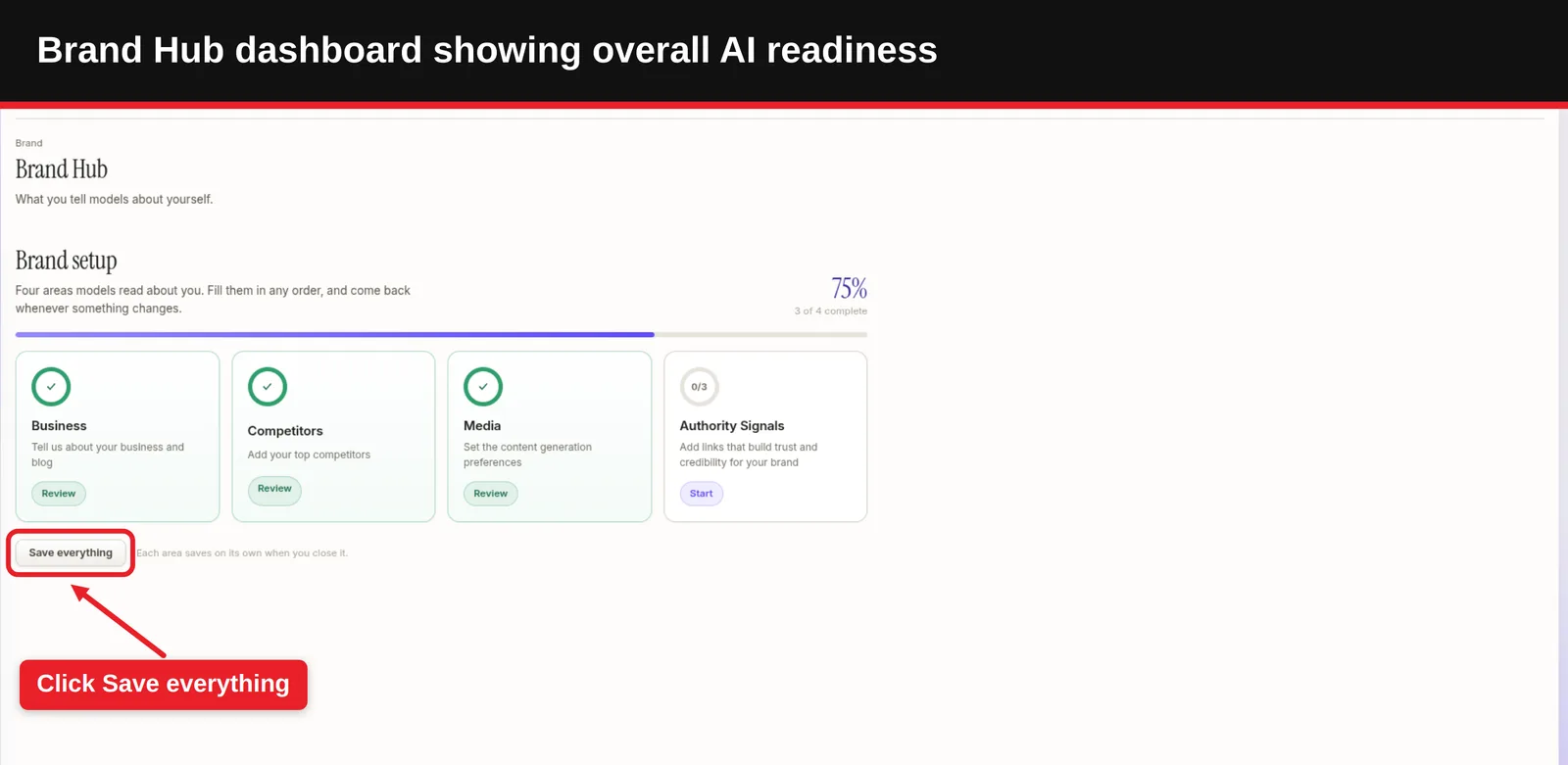
- Open the door to AI crawlers: Check robots.txt for OAI-SearchBot, PerplexityBot, Googlebot and other crawlers you want to allow. Our free AI readiness audit checks crawler access, structure and markup against what answer engines need.
- Publish answer-first pages: For each buyer question, write a page or section that answers it in the first two to three sentences, then adds detail, examples and sourced numbers.
- Make brand facts consistent and explicit: State what you do, who it's for, pricing and key features in plain text, and keep them identical across your homepage, pricing page, docs and profiles.
- Earn third-party mentions: Get listed in relevant comparisons, review sites, directories and industry publications, and take part honestly in communities where your buyers ask questions.
- Measure and correct: Track your buyer questions across AI engines, note where you're missing or misdescribed, and fix the source content.
Example
| Finding | Likely cause | Action |
|---|---|---|
| ChatGPT never names you for "best X for Y" | Few third-party lists include you | Pitch inclusion in relevant comparisons and reviews |
| Perplexity quotes an old price | Outdated pricing on a cited page | Update the page and your own pricing copy |
| Gemini describes the wrong product category | Vague positioning on your homepage | State your category clearly in plain text |
What Done Looks Like
AI crawlers can reach you, your key answers are published, and you have a baseline of how AI engines describe you today.
Step 7: Use Tools That Help
What You're Doing
The playbook only works if you can see its effect. You're choosing tools to measure AI visibility, because you can't improve what you don't track.
How to Do It
- Use Google Search Console for indexing and overall search performance.
- Use an AI visibility tracker to run your buyer questions across AI engines on a schedule and record mentions, citations and sentiment.
- Compare options on data accuracy, engine coverage and competitor analysis; our guide on how to choose an AI search optimization tool walks through the criteria, and our roundup of AEO tools compares options.
This is the job hyperank was built for. We believe brands need transparency and control over how AI engines represent them. hyperank asks six major AI engines the questions your buyers ask every day, keeps every answer, and shows what was said about you, what was wrong and who was recommended instead. It captures the answers themselves, not just a score, so you can see what to fix. If you'd rather have help doing the work, our services page explains how we work with teams.
What Done Looks Like
You have a weekly or daily view of how often AI engines mention and cite you, and how that compares with competitors.
What to Do After Setting Up
- Phase 1, first month, baseline and fix errors: Record how each engine answers your buyer questions and correct any factual mistakes at the source.
- Phase 2, months two to three, fill gaps: Publish answer-first content for questions where competitors are named and you aren't, and pursue third-party mentions.
- Phase 3, ongoing, monitor and iterate: Review trends monthly, refresh pages that AI engines cite, and expand your question set as your market changes.
Resources You'll Need
| Resource | Role | Label | Price |
|---|---|---|---|
| hyperank | Daily tracking of what six AI engines say about your brand and competitors | Recommended | Paid plans |
| hyperank AI readiness audit | Checks crawler access, structure and markup | Recommended | Free |
| Google Search Console | Indexing and search performance, including AI features traffic | Required | Free |
| Google's AI features documentation | Official guidance for AI Overviews and AI Mode | Required | Free |
| OpenAI crawler documentation | How to allow OAI-SearchBot for ChatGPT search | Recommended | Free |
Troubleshooting Common Issues
AI engines never mention your brand
Likely cause: Little third-party coverage, or crawlers blocked. Fix: Check robots.txt for AI crawlers, then work on inclusion in comparisons, reviews and industry lists.
AI describes your brand incorrectly
Likely cause: Outdated or inconsistent information on your site or on pages that cite you. Fix: Correct and align the facts on your own pages first, then ask third-party sites to update theirs.
You rank on Google but don't appear in AI Overviews
Likely cause: The answer is buried, or the page isn't snippet-eligible. Fix: Put a direct answer at the top, check for nosnippet tags, and follow Google's AI features guidance.
Results change from day to day
Likely cause: AI answers vary between runs; ask the same question twice and you may get two different shortlists. Fix: Track the same questions repeatedly and judge trends over weeks, not single answers.
Conclusion
AI search optimization, whether you call it GEO, AEO or AI SEO, is about being named, cited and described correctly when people ask AI for answers. It builds on SEO fundamentals and adds crawler access, answer-first content, consistent brand facts, third-party mentions and answer tracking.
Key Takeaways
- Outcome: A clear definition and a five-step plan to get your brand into AI answers.
- Key insight: Google says no special optimization is needed for its AI features; the gains come from fundamentals plus tracking what AI actually says.
- Next action: Write down 20 buyer questions and check how three AI engines answer them this week.
FAQ
What is AI search optimization, and how do you get your brand into AI answers?
AI Search Optimization: What It Is and How to Get Your Brand Into AI Answers starts with a simple definition: it's improving how often and how accurately your brand appears in answers from ChatGPT, Gemini, Perplexity, Claude and Google's AI Overviews and AI Mode. To get into those answers, allow AI crawlers such as OAI-SearchBot and PerplexityBot in robots.txt, publish answer-first pages with specific, sourced facts, keep brand facts consistent across your site, earn mentions in reviews and comparisons, and track your buyer questions across AI engines to find and fix gaps.
What is AI search optimization called?
It's commonly called GEO (generative engine optimization), AEO (answer engine optimization) or AI SEO. The terms overlap and are often used interchangeably.
How does AI search optimization work?
AI engines answer from what they learned in training and, often, from pages they retrieve at question time. Optimization makes your pages reachable, easy to quote and backed by credible third-party mentions.
What is the difference between SEO and AI search optimization?
SEO aims for rankings and clicks; AI search optimization aims for mentions, citations and accurate descriptions in AI answers. Most SEO fundamentals still apply.
Is there a Google AI search optimization guide?
Yes. Google's Search Central page on AI features explains that there are no extra requirements: pages need to be indexed and snippet-eligible, and standard SEO best practices apply.
How long does AI search optimization take to work?
Fixes to retrievable pages can show up within weeks in engines that search the web live. Changes in what models learned in training take longer, so track trends over months.
How do I measure AI search optimization?
Track a fixed set of buyer questions across AI engines over time and record mentions, citations, accuracy and competitors named. Tools like hyperank automate this daily.
Methodology: This guide draws on Google Search Central's documentation on AI features, OpenAI and Perplexity crawler documentation, the 2023 GEO research paper, Alphabet's Q2 2025 results as reported by 9to5Google, and Pew Research Center click data. AI answers vary between runs and change over time; no approach guarantees inclusion in AI answers.
See where your brand stands
How six AI engines describe you, next to your competitors. About two minutes.