
How to Check Domain Authority (and What the Score Actually Means)
Learn how to use a domain rank checker to assess your website's authority and understand what the score means for your online presence.
domain rank checker | Updated October 2026 | hyperank Editorial Team | 5-10 minutes | Beginner
What You'll Learn
To check domain authority, enter a domain into a free domain rank checker such as hyperank's domain rating checker, Moz's Link Explorer or Ahrefs' website authority checker. You'll get a score from 0 or 1 to 100 that estimates the strength of the site's backlink profile. Moz calls it Domain Authority (DA), Ahrefs calls it Domain Rating (DR) and Semrush calls it Authority Score; they use different data and formulas, so the same site gets different numbers. None of them is used by Google, so treat the score as a way to compare sites, not as a ranking factor. This guide, How to Check Domain Authority (and What the Score Actually Means), explains each metric, how to check it, what counts as a good score and how to improve it.
- What the metrics measure: DA, DR and Authority Score explained plainly.
- How to check any domain: Free tools and what each result means.
- What's a good score: Why it depends on your competitors.
- How to raise it: Link-earning tactics that also help real rankings.
Prerequisites: The domain you want to check, plus two or three competitor domains for comparison.
Why Checking Domain Authority Matters in 2026
Domain authority scores are a quick way to size up a website's link strength. SEOs use them to compare competitors, judge link opportunities, and track whether a link-building effort is moving the needle.
The catch is that they're often misunderstood. Ahrefs' own explanation of Domain Rating describes DR as showing "the strength of a website's backlink profile compared to the others in our database on a 100-point scale." It's a third-party estimate built on one company's link index, not a number Google calculates or uses.
Used correctly, a domain rank checker helps you answer practical questions: is this competitor out of reach for now, is this site worth a guest post, and is our link profile growing?
The Process at a Glance
| Step | Action | Time | Outcome |
|---|---|---|---|
| 1 | Understand what domain authority is | 2 min | Know what the score measures |
| 2 | Compare DA, DR and Authority Score | 3 min | Pick the right metric |
| 3 | Check the score with a free tool | 1 min | Score for any domain |
| 4 | Judge whether the score is good | 3 min | Score in competitive context |
| 5 | Plan how to improve it | 5 min | Link-earning action list |
Total time: About 5 to 10 minutes to check and compare; improving the score takes months.
Step 1: Understand What Domain Authority Is
What You're Doing
Before you look at a number, you're getting clear on what it actually represents, so you don't over-read it.
How to Do It
- Know the origin: Domain Authority is a score created by Moz, from 1 to 100, intended to predict how likely a website is to rank in search results relative to others.
- Know the inputs: it's built mainly from backlink data, such as how many unique domains link to a site and how strong those linking sites are.
- Know the scale: these scores are relative and logarithmic, so moving from 20 to 30 is far easier than moving from 70 to 80.
- Know the limit: Google doesn't use Moz's DA or any similar third-party score. Google representatives have repeatedly said Google has no overall "domain authority" metric of this kind.
What Done Looks Like
You can explain that domain authority is a third-party estimate of link strength, useful for comparison but not a Google ranking factor.
Step 2: Compare DA vs DR vs Authority Score
What You're Doing
Once you know what the score is, the next source of confusion is that there are three of them. You're learning how they differ so you compare like with like.
How to Do It
| Metric | Provider | Scale | Based on |
|---|---|---|---|
| Domain Authority (DA) | Moz | 1 to 100 | Moz's link index, modelled to predict ranking likelihood |
| Domain Rating (DR) | Ahrefs | 0 to 100 | Strength of the backlink profile in Ahrefs' database |
| Authority Score (AS) | Semrush | 1 to 100 | Link power, organic traffic and spam factors combined |
- Ahrefs DR: Ahrefs says higher-DR domains pass more value to the sites they link to, and a domain's rating is shared across all the sites it links to, so a link from a site that links out to few domains counts for more.
- Semrush Authority Score: Semrush's Authority Score documentation describes it as a compound metric that grades the overall quality of a website, combining link power, estimated organic traffic and signals of a natural link profile.
- Why numbers differ: Each tool crawls the web separately, so their link indexes, and therefore their scores, never match exactly.
Common Mistakes
- Comparing across tools: A DA of 40 and a DR of 40 aren't equivalent. Compare sites using the same metric.
What Done Looks Like
You've chosen one metric to use consistently for all your comparisons.
Step 3: Check It Free With the Domain Rating Checker
What You're Doing
With a metric chosen, it's time to see where you stand. You're getting the actual number for your site and your competitors.
How to Do It
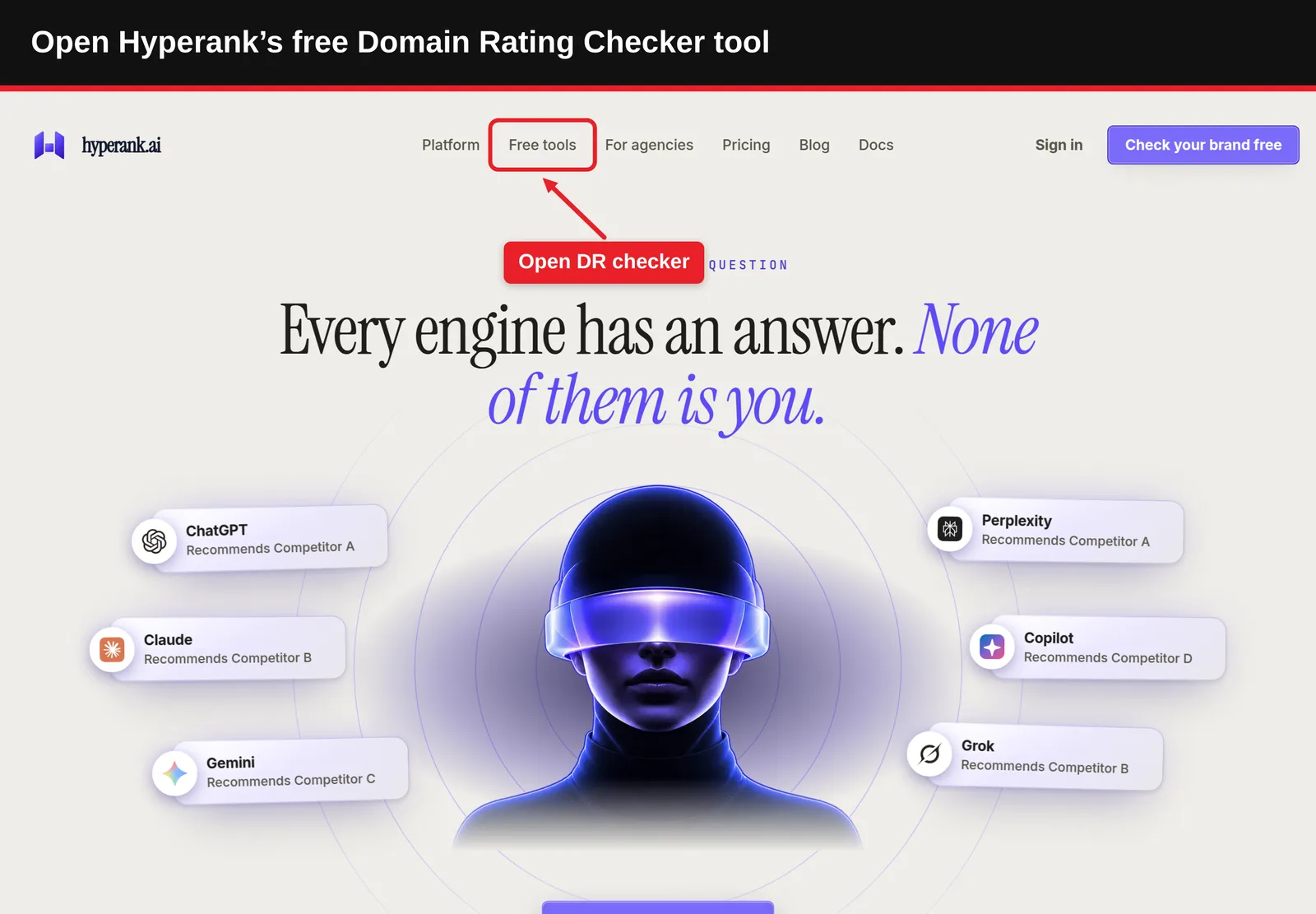
- Open hyperank's free domain rating checker.
- Enter the domain without paths, for example example.com.
- Read the result: the tool returns the site's Ahrefs Domain Rating on the 0 to 100 scale, plus a label showing where it sits, from low to exceptional.
- Repeat for two or three direct competitors and note the scores in a spreadsheet.
- For Moz DA, use Moz Link Explorer (free with a Moz account, with usage limits); for Authority Score, use Semrush.
Example
| Domain | DR | Label | Takeaway |
|---|---|---|---|
| yoursite.com | 24 | Low to moderate | Room to grow |
| competitor-a.com | 31 | Moderate | Within reach with steady link earning |
| competitor-b.com | 68 | Strong | Compete on specific topics, not head terms |
The figures above are an illustration of how to log and read results, not real sites.
What Done Looks Like
You have scores for your site and your main competitors from the same tool.
Step 4: Decide What a Good Score Is
What You're Doing
A number on its own tells you surprisingly little. A score only means something next to others, so you're putting yours in context.
How to Do It
- Compare against the sites you compete with, not against Wikipedia or major news sites. A local bakery with a DR of 20 may outrank every rival in its city.
- Look at the sites ranking for your target keywords. If the top results all score above 60 and you're at 15, aim for longer-tail queries first.
- Track the trend, not the snapshot. A steady climb matters more than any single number.
- Expect drops you didn't cause. Because scores are relative, they can dip when the tool updates its index or when other sites grow faster.
| Score range | Typical sites | What it usually means |
|---|---|---|
| 0 to 20 | New sites, small local businesses | Few referring domains; focus on basics |
| 20 to 40 | Established small businesses, niche blogs | Growing link profile |
| 40 to 60 | Strong niche players, mid-size brands | Competitive in most niches |
| 60 and above | Large brands, major publishers | Very strong link profiles |
These bands are rough rules of thumb, not official thresholds from Moz, Ahrefs or Semrush.
What Done Looks Like
You can say whether your score is behind, level with or ahead of your real competitors.
Step 5: Improve Your Domain Authority
What You're Doing
If the comparison stings a little, that's normal. Because these scores are built mostly on links, raising them means earning more links from relevant, trusted sites, which also tends to help real rankings.
How to Do It
- Create link-worthy assets: Original data, free tools, templates and genuinely useful guides attract links naturally.
- Get listed where it counts: Industry directories, partner pages, supplier and customer case studies.
- Do digital PR: Pitch journalists with data or expert comment relevant to their beat.
- Reclaim lost links: Fix broken pages that used to earn links, or redirect them to the best replacement.
- Turn mentions into links: Ask sites that mention your brand without linking to add a link.
- Strengthen internal links: They don't change DA directly, but help authority flow to the pages you want to rank.
Common Mistakes
- Buying links: Google's spam policies treat buying links for ranking purposes as link spam. Our guide on whether you should buy backlinks explains the risks.
- Chasing the number: Some services inflate third-party scores with low-quality links that don't help rankings at all.
What Done Looks Like
You have a short list of link-earning activities and a monthly check-in on your score.
What to Do After Checking Your Score
- Phase 1, this week, benchmark: Record your score and three competitors' scores in one sheet using one tool.
- Phase 2, next three months, earn links: Publish one link-worthy asset and pursue five to ten relevant link opportunities.
- Phase 3, ongoing, review monthly: Track the score alongside the metrics that matter more: rankings, organic traffic and leads.
Authority is also increasingly about what AI engines say about you, not just who links to you. hyperank believes brands need transparency and control over how AI engines represent them. hyperank asks six major AI engines the questions your buyers ask every day and shows what they say about your brand, what they get wrong and which competitors they mention.
Resources You'll Need
| Resource | Role | Label | Price |
|---|---|---|---|
| hyperank domain rating checker | Check any domain's DR, 0 to 100 | Recommended | Free |
| Moz Link Explorer | Check Moz Domain Authority | Optional | Free account with limits; paid plans |
| Semrush Authority Score | Compound score including traffic and spam signals | Optional | Paid plans with limited free use |
| Google Search Console | Your real links report and search performance | Required | Free |
| hyperank | Tracks what six AI engines say about your brand | Optional | Paid plans |
Troubleshooting Common Issues
Your score dropped but nothing changed
Likely cause: The tool updated its index or model, or competitors gained links faster. Fix: Check whether competitors dropped too; if so, it's a recalibration, not a problem.
Different tools give very different scores
Likely cause: Separate link indexes and formulas. Fix: Pick one metric and use it consistently.
Your score rose but rankings didn't
Likely cause: The new links aren't relevant, or the content doesn't match search intent. Fix: Focus on relevant links and on improving the pages you want to rank.
Conclusion
A domain rank checker gives you a quick, comparable view of a site's link strength. Use one metric consistently, judge it against real competitors, and improve it by earning relevant links, while remembering Google doesn't use any of these scores.
Key Takeaways
- Outcome: You can check DA, DR or Authority Score for any site and read it in context.
- Key insight: These are third-party estimates built on links, useful for comparison but not Google ranking factors.
- Next action: Check your domain and three competitors with the free domain rating checker today.
FAQ
How do you check domain authority, and what does the score actually mean?
How to Check Domain Authority (and What the Score Actually Means): enter a domain into a free domain rank checker, such as hyperank's domain rating checker for Ahrefs DR or Moz Link Explorer for Moz DA, and you'll get a score out of 100. The score estimates the strength of the site's backlink profile compared with other sites in that tool's database. It's logarithmic and relative, so compare it only against competitors using the same tool. Google doesn't use DA, DR or Authority Score, so treat them as benchmarks, not ranking factors.
Is domain authority a Google ranking factor?
No. Domain Authority is Moz's metric, and Google doesn't use it or any other third-party authority score.
What is a good domain authority score?
One that's competitive with the sites ranking for your target keywords. For many small businesses, 20 to 40 is normal; large brands often score above 60.
What is the difference between DA and DR?
DA is Moz's score and DR is Ahrefs'. Both run to 100 and are built from links, but on different link indexes and formulas, so the same site gets different numbers.
How long does it take to increase domain authority?
Usually months. Scores rise as you earn links from relevant, trusted sites, and higher scores are harder to move because the scale is logarithmic.
Can I check domain authority for free?
Yes. hyperank's domain rating checker is free, and Moz offers limited free checks with an account.
Methodology: Metric definitions come from each provider's own documentation (Ahrefs on Domain Rating, Semrush on Authority Score) and Moz's published description of Domain Authority. Score bands are rules of thumb, not official thresholds. Example scores are illustrative.
See where your brand stands
How six AI engines describe you, next to your competitors. About two minutes.