> ## Content Index
> Fetch the complete content index at: https://www.hyperank.ai/blog/llms.txt
> Use this file to discover other available public pages before exploring further.
# FAQ Schema in 2026: Is It Still Worth Adding? (Examples and Setup)
- URL: https://www.hyperank.ai/blog/faq-schema/
- Published: 2026-10-27T19:30:05.000Z
- Updated: 2026-10-27T19:30:05.000Z
- Description: Discover the importance of faq schema in 2026 with our step-by-step guide, including examples and setup tips for better search visibility.
- Author: Hyperank AI
*faq schema | Updated October 2026 | hyperank Editorial Team | 15-30 minutes | Beginner*
## What You'll Learn
**FAQ schema is FAQPage structured data: a JSON-LD block that marks up questions and answers on a page using the Schema.org vocabulary. It's no longer worth adding for Google rich results, because Google stopped showing the FAQ rich result on May 7, 2026 and has since removed its documentation. It can still be added as valid Schema.org markup, but there's no published evidence that it helps AI answers, and Google says no special schema is needed for AI Overviews or AI Mode. The better investment is a clear, visible FAQ section on the page, plus structured data Google still supports, such as LocalBusiness for local businesses.** This guide, FAQ Schema in 2026: Is It Still Worth Adding? (Examples and Setup), explains what changed, when FAQ markup still makes sense, and gives FAQPage and LocalBusiness JSON-LD examples you can copy.
- **What FAQ schema is:** And how it relates to visible FAQ content.
- **What Google changed:** The 2023 restriction and the 2026 retirement.
- **Whether it's still relevant:** An honest view on AI answers and citations.
- **Working examples:** FAQPage and LocalBusiness JSON-LD, and a free generator.
**Prerequisites:** Access to your page templates or CMS, and a page with real questions and answers.
---
## Why FAQ Schema Matters (and Matters Less) in 2026
For years, FAQ schema was one of the easiest wins in SEO, and plenty of us added it to every page we touched: add a block of JSON-LD and your Google result could expand with clickable questions. That made it one of the most widely used structured data types.
That era is over. Google first limited FAQ rich results in August 2023 to well-known, authoritative government and health websites, as its [Search Central announcement](https://developers.google.com/search/blog/2023/08/howto-faq-changes?ref=hyperank.ai) explained. Then, according to Google's [Search Central documentation changelog](https://developers.google.com/search/updates?ref=hyperank.ai#removing-faq-rich-result), the FAQ rich result "will no longer appear in Google Search starting May 7, 2026," and Google later removed the FAQ rich result documentation because the feature "is no longer shown in Google Search results."
So the question for 2026 isn't how to get FAQ rich results. It's whether FAQ markup does anything useful at all, and what to do instead.
---
## The Process at a Glance
| Step | Action | Time | Outcome |
| ---- | --------------------------------------- | ------ | ----------------------------- |
| 1 | Understand what FAQ schema is | 3 min | Clear definition |
| 2 | Learn what Google changed | 3 min | Know rich results are gone |
| 3 | Decide whether FAQ schema is relevant | 5 min | Keep, skip or remove |
| 4 | Copy a FAQPage JSON-LD example | 5 min | Valid FAQ markup if needed |
| 5 | Add LocalBusiness markup where relevant | 10 min | Supported local business data |
| 6 | Generate and test with free tools | 5 min | Validated JSON-LD live |
**Total time:** 15 to 30 minutes per page template.
---
## Step 1: Understand What FAQ Schema Is
### What You're Doing
You're separating two things people often mix up: the visible FAQ section on a page, and the hidden markup that describes it.
### How to Do It
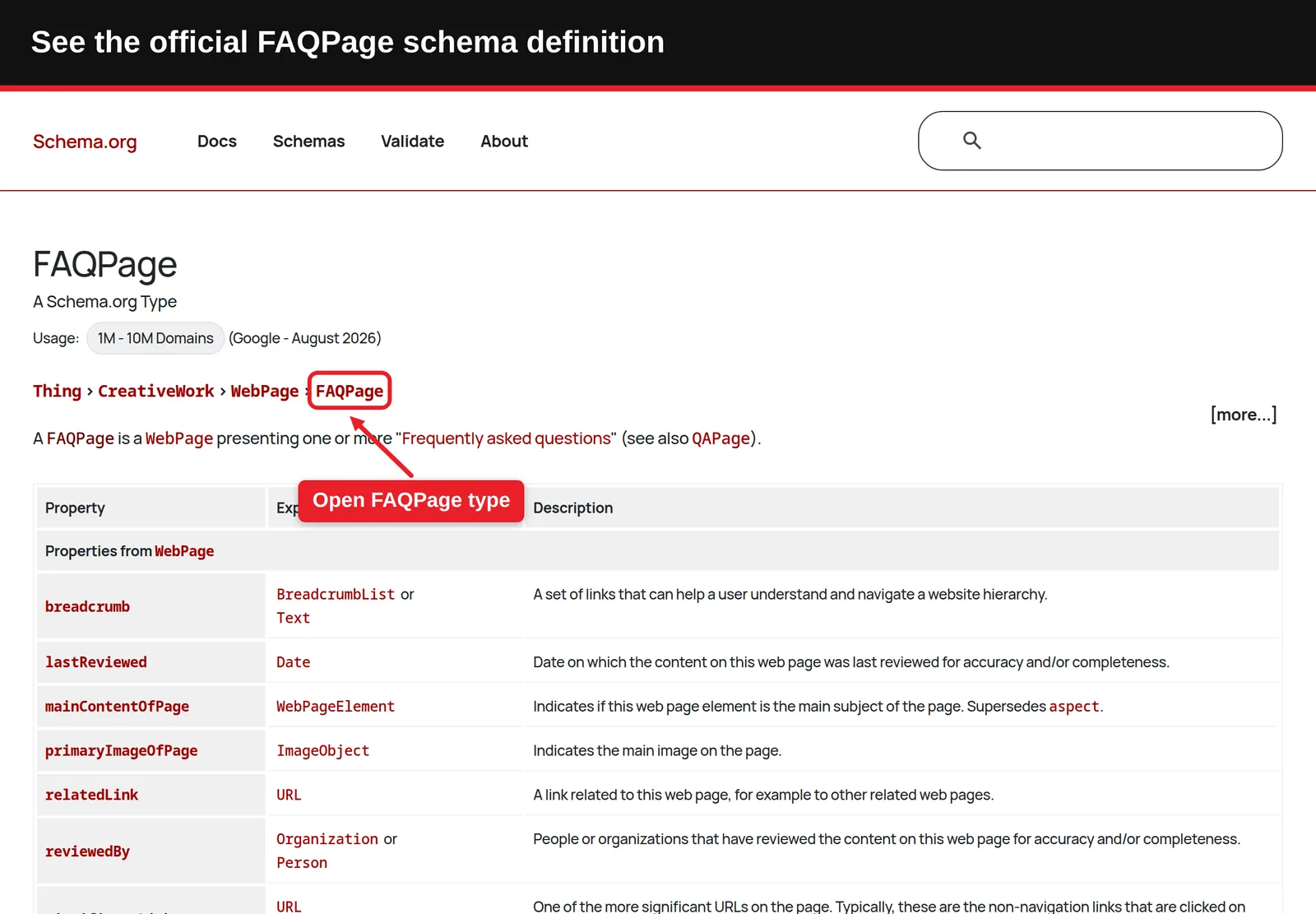
1. Know the type: [FAQPage](https://schema.org/FAQPage?ref=hyperank.ai) is a Schema.org type for a page containing a list of frequently asked questions and answers.
2. Know the structure: a FAQPage contains mainEntity items, each a Question with a name (the question) and an acceptedAnswer containing an Answer with text.
3. Know the format: it's usually written as JSON-LD, a script block in the page's HTML that visitors don't see.
4. Know the rule that always applied: the markup must match questions and answers that are actually visible on the page.
For a broader introduction to structured data, see our guide on [what schema markup is](https://www.hyperank.ai/blog/what-is-schema-markup/).
### What Done Looks Like
You can explain that FAQ schema is code describing a visible FAQ, not the FAQ content itself.
---
## Step 2: Know Whether FAQ Schema Is Deprecated: What Google Changed
### What You're Doing
Once you know what the markup is, the next question is what Google did with it. You're getting the timeline right, because a lot of advice online still predates it.
### How to Do It
| Date | Change | Source |
| ----------- | -------------------------------------------------------------------------------------- | -------------------------------------- |
| August 2023 | FAQ rich results limited to well-known, authoritative government and health sites | Google Search Central blog |
| May 2026 | Deprecation notice added; FAQ rich result no longer appears in Search from May 7, 2026 | Search Central documentation changelog |
| June 2026 | FAQ rich result documentation removed | Search Central documentation changelog |
- **Is FAQ schema deprecated?** For Google rich results, yes: the feature no longer appears in Google Search.
- **Is the markup invalid?** No. FAQPage is still a valid Schema.org type; Google just no longer uses it to display a rich result.
- **Will it hurt you?** There's no indication that valid FAQ markup harms a page. Google's [structured data policies](https://developers.google.com/search/docs/appearance/structured-data/sd-policies?ref=hyperank.ai) note that structured data manual actions affect rich result eligibility, not rankings.
### What Done Looks Like
You know FAQ rich results are gone from Google, and that existing markup doesn't need emergency removal.
---
## Step 3: Decide Whether FAQ Schema Is Still Relevant: AI Answers and Citations
### What You're Doing
With rich results gone, the remaining argument for FAQ schema is AI. You're weighing that claim honestly.
### How to Do It
1. **Check Google's position:** Google's guidance on [AI features and your website](https://developers.google.com/search/docs/appearance/ai-features?ref=hyperank.ai) says "there's also no special schema.org structured data that you need to add" to appear in AI Overviews or AI Mode, and asks that structured data match the visible text on the page.
2. **Check other AI engines:** OpenAI, Perplexity and Anthropic haven't published documentation saying FAQPage markup influences their answers or citations.
3. **Value the visible content:** A well-written FAQ section that answers real questions directly is useful to readers and easy for any system to quote, with or without markup.
4. **Decide per site:** Use the table below.
| Situation | Recommendation |
| ---------------------------------------------------- | ---------------------------------------------------------------- |
| Your CMS or SEO plugin adds FAQ markup automatically | Fine to leave on, as long as it matches visible content |
| You're considering custom FAQ markup work | Low priority; invest in the visible FAQ content instead |
| You only added FAQs to get rich results | Keep FAQs that help readers; cut filler questions |
| You're a local business | Prioritise LocalBusiness markup and your Google Business Profile |
Because AI engines don't publish how they choose sources, the practical move is to measure rather than guess. hyperank asks six major AI engines the questions your buyers ask every day and shows what they say about your brand, what they get wrong and which competitors they mention. We built it because we believe brands need visibility and control over how AI represents them, especially when the rules aren't public.
### What Done Looks Like
You've decided, per template, whether to keep, skip or remove FAQ markup, based on evidence rather than habit.
---
## Step 4: Use a FAQPage Example (JSON-LD)
### What You're Doing
For the pages where you're keeping it, correctness matters more than ever. You're making sure the FAQ markup is valid and matches the page.
### How to Do It
1. Write the visible FAQ on the page first.
2. Add it to the page's HTML, usually in the head or just before the closing body tag.
3. Keep the answers identical to what visitors see.
Copy this FAQPage example and replace the questions and answers with your exact visible text:
```
```
### Common Mistakes
- **Marking up hidden or invented FAQs:** Markup for questions that aren't on the page conflicts with Google's structured data guidelines.
- **Using FAQPage for user Q&A:** Pages where users submit answers fit the QAPage type, not FAQPage.
### What Done Looks Like
Your FAQPage block lists exactly the questions and answers shown on the page.
---
## Step 5: Add a LocalBusiness Example Where It Fits
### What You're Doing
For local businesses, LocalBusiness markup is the structured data that still matters. Google says it can show details like hours in a knowledge panel when people search for your business.
### How to Do It
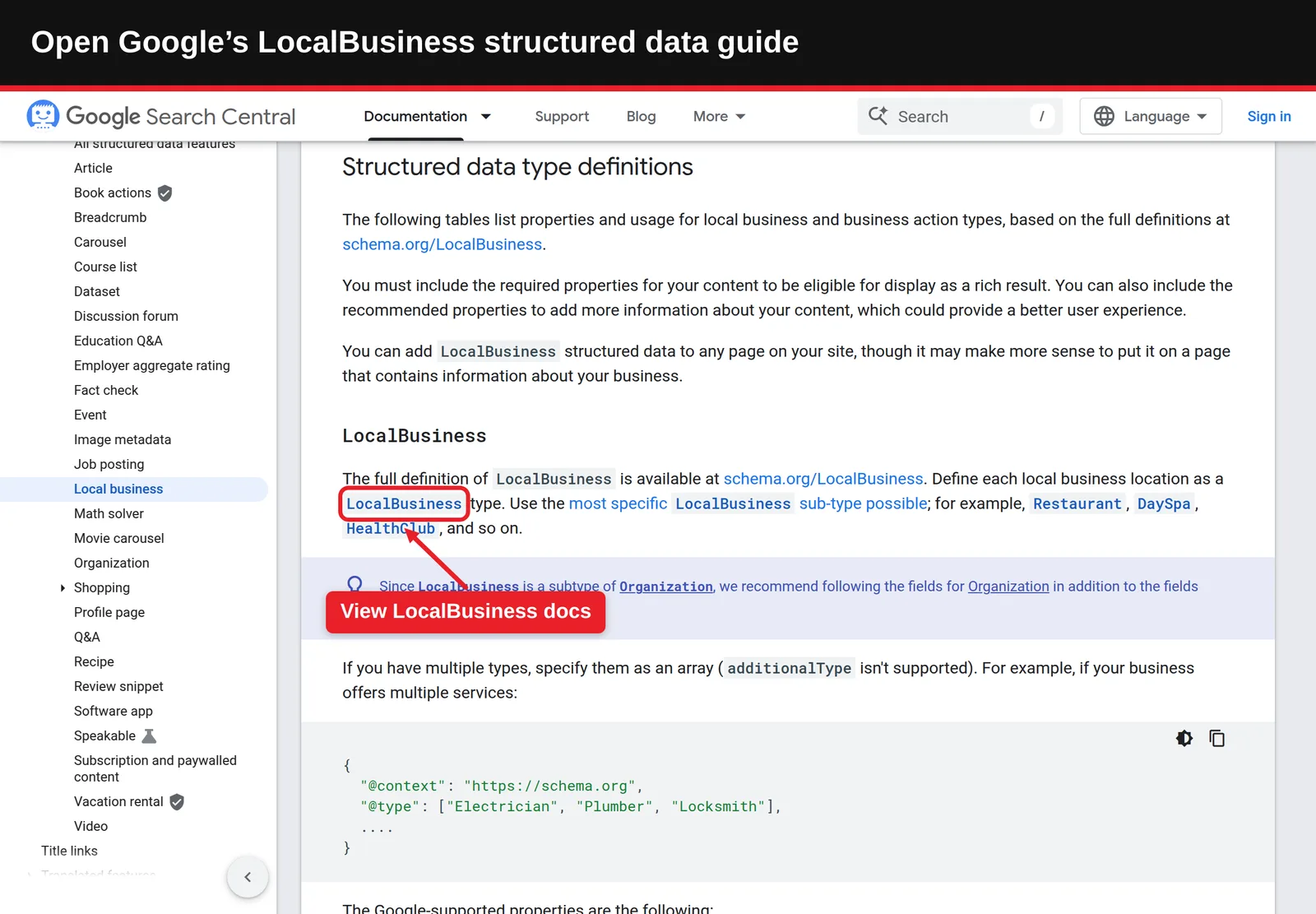
1. Read Google's [LocalBusiness structured data guide](https://developers.google.com/search/docs/appearance/structured-data/local-business?ref=hyperank.ai). It lists address and name as required properties, recommends opening hours, telephone and URL, and advises using the most specific sub-type, such as Restaurant or HealthClub.
2. Use one LocalBusiness block per location page.
3. Keep the details identical to your Google Business Profile and the visible page.
Adapt this example with your real details:
```
```
### What Done Looks Like
Each location page carries valid LocalBusiness markup with a name, address, phone, hours and URL that match everywhere else.
---
## Step 6: Generate It With the Free Schema Generator
### What You're Doing
Hand-written JSON-LD is easy to break with one missing comma. Instead, you're using a tool to build it and catch missing fields, then testing the result.
### How to Do It
1. Open hyperank's free [schema markup generator](https://www.hyperank.ai/tools/technical-seo/schema-markup-generator?ref=hyperank.ai).
2. Pick FAQPage or LocalBusiness from the schema type list (it also supports Article, Organization, Product, Event and more).
3. Enter one property per line as key: value. The tool flags missing required properties.
4. Copy the JSON-LD into your page.
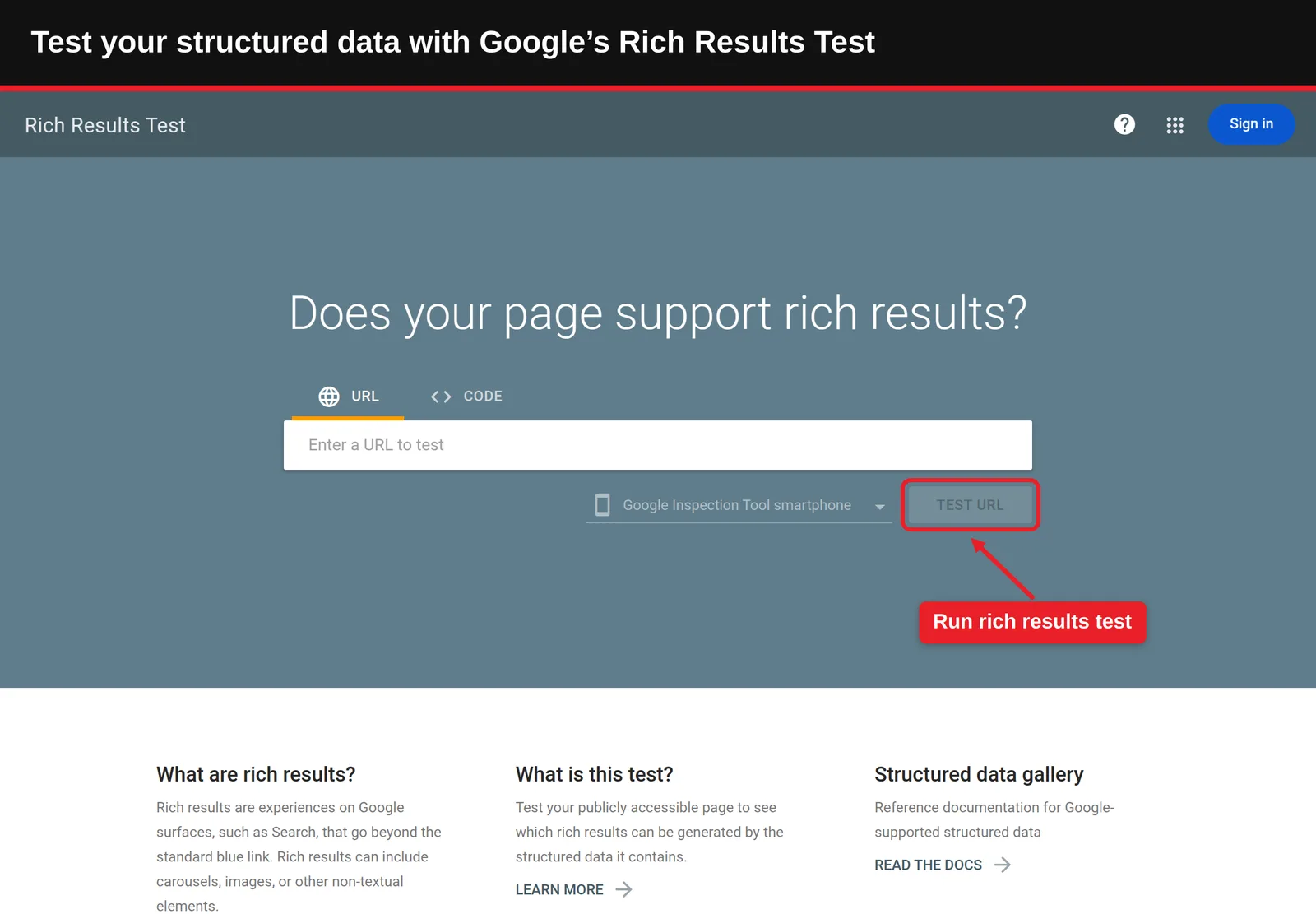
5. Test it: use Google's [Rich Results Test](https://search.google.com/test/rich-results?ref=hyperank.ai) for supported features such as LocalBusiness, and the [Schema Markup Validator](https://validator.schema.org/?ref=hyperank.ai) for general Schema.org syntax, including FAQPage.
Our guide to [schema markup validators](https://www.hyperank.ai/blog/schema-markup-validator/) explains which test to use when.
### What Done Looks Like
Your JSON-LD is live and passes validation with no errors.
---
## What to Do After Updating Your Schema
- **Phase 1, this week, audit:** List templates that output FAQ markup and confirm it matches visible content.
- **Phase 2, this month, refocus:** Improve visible FAQ answers and add LocalBusiness or other supported types where they fit.
- **Phase 3, ongoing, watch for changes:** Check Google's Search Central changelog, since supported features keep changing.
---
## Resources You'll Need
| Resource | Role | Label | Price |
| ------------------------------------------------------------------------------------------------------ | ----------------------------------------------- | ----------- | ---------- |
| hyperank schema markup generator | Builds FAQPage, LocalBusiness and other JSON-LD | Recommended | Free |
| Schema Markup Validator | Checks Schema.org syntax | Required | Free |
| Google Rich Results Test | Tests eligibility for supported Google features | Recommended | Free |
| [Search Central documentation changelog](https://developers.google.com/search/updates?ref=hyperank.ai) | Tracks which features Google supports | Recommended | Free |
| hyperank | Tracks what six AI engines say about your brand | Optional | Paid plans |
---
## Troubleshooting Common Issues
### FAQ rich results disappeared from your listings
**Likely cause:** Google retired the FAQ rich result in May 2026\. **Fix:** Nothing to fix on your side; focus on titles, descriptions and content.
### The Rich Results Test doesn't recognise FAQPage
**Likely cause:** Google no longer supports the FAQ rich result. **Fix:** Use the Schema Markup Validator to check syntax instead.
### LocalBusiness markup shows errors
**Likely cause:** A missing required property such as address, or a malformed time format. **Fix:** Add the missing field and use the time format shown in Google's LocalBusiness examples, such as "11:00".
---
## Conclusion
FAQ schema is still valid Schema.org markup, but Google retired the FAQ rich result in May 2026, and there's no published evidence it boosts AI citations. Keep it only where it's automatic and accurate, put your effort into visible FAQ content, and use supported types like LocalBusiness.
### Key Takeaways
- **Outcome:** You know what FAQ schema is, what Google changed and what to do with existing markup.
- **Key insight:** The visible FAQ content matters more than the markup now.
- **Next action:** Check your templates this week and add LocalBusiness markup if you serve local customers.
---
## FAQ
### Is FAQ schema still worth adding in 2026, and how do you set it up?
FAQ Schema in 2026: Is It Still Worth Adding? (Examples and Setup): mostly not for Google. Google stopped showing the FAQ rich result on May 7, 2026 and has removed its documentation, and it says no special schema is needed for AI Overviews or AI Mode. FAQPage is still valid Schema.org markup, so it's fine to keep if your CMS adds it and it matches your visible FAQ. To set it up, write the FAQ on the page, add a FAQPage JSON-LD block with each Question and acceptedAnswer, generate it with a free schema generator and validate it with the Schema Markup Validator.
### What is FAQ schema?
It's FAQPage structured data: JSON-LD that labels the questions and answers on a page using Schema.org.
### Is FAQ schema deprecated?
For Google rich results, yes. The feature stopped appearing in Google Search from May 7, 2026\. The Schema.org type itself still exists.
### Does FAQ schema help with AI answers?
There's no published evidence that it does. Google says AI features need no special schema, and other AI engines haven't documented using it.
### Should I remove existing FAQ schema?
There's no urgency if it's valid and matches visible content. Remove it if it marks up hidden or invented questions.
### What is a FAQPage schema example?
A JSON-LD block with "@type": "FAQPage" and a mainEntity list of Question items, each with a name and an acceptedAnswer containing the answer text. See Step 4.
---
*Methodology: FAQ rich result changes are taken from Google's August 2023 Search Central announcement and the Search Central documentation changelog entries for May and June 2026\. LocalBusiness requirements come from Google's LocalBusiness structured data guide. Statements about AI engines are limited to what their providers have published.*