
how to choose a generative engine optimization tool
Discover essential tips and strategies on how to choose a generative engine optimization tool that best fits your business needs and goals.
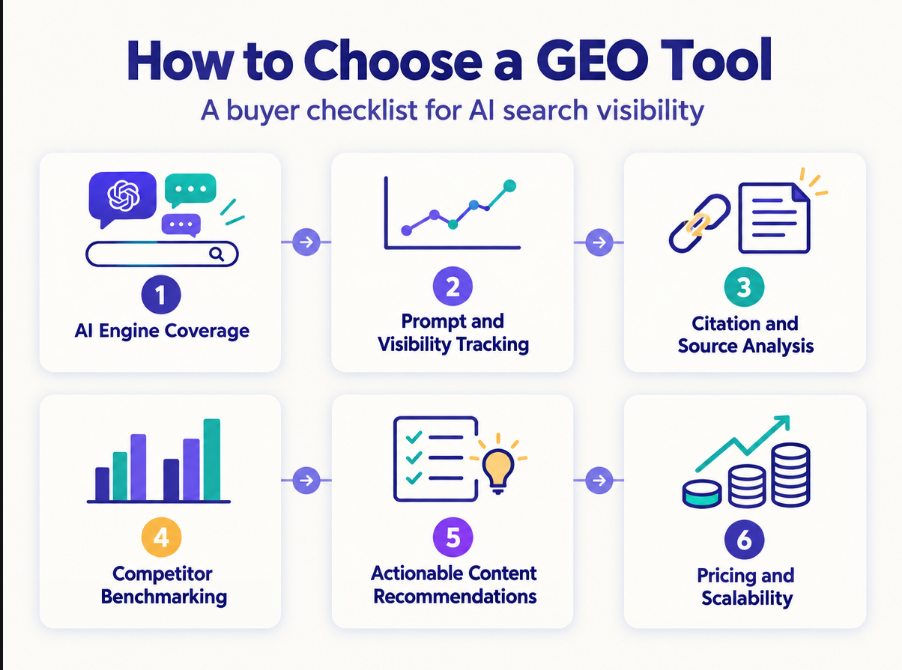
how to choose a generative engine optimization tool | September 18, 2026 | 9 min read | Hyperank Editorial Team
Choosing a generative engine optimization tool means evaluating vendors across three non-negotiable pillars: multi-engine coverage (ChatGPT, Perplexity, Google AI Overviews, and more), authentic prompt-level data pulled from real user queries, and daily competitive benchmarking. Your marketing and competitive intelligence teams need to test prospective software against your own prompt sets and named competitors using a standardized evaluation framework before signing anything.
The AI search software market is growing fast. MarketsandMarkets estimates the generative engine optimization market hit USD 390 million in 2025 and is expected to climb to USD 4,250 million by 2032, expanding at a 41% CAGR from 2026 to 2032. In the United States alone, Market Decipher projects the U.S. GEO market will reach USD 365 million in 2026 and climb to USD 6.36 billion by 2034, representing over 40% of global GEO revenue.
Market Decipher data shows 67% of Fortune 500 CMOs have identified GEO as a top-three digital priority for fiscal year 2026, up from just 18% in 2024. This guide walks through concrete evaluation criteria, common traps, and an actionable scoring rubric.
The vendors with the most polished landing pages often have the thinnest AI engine coverage. Test any generative engine optimization tool against your own prompts and your own competitors before you trust its dashboard.
What Does a Generative Engine Optimization Tool Actually Do?
A generative engine optimization tool tracks, analyzes, and optimizes how AI answer engines like ChatGPT, Google AI Overviews, Perplexity, and Claude describe, cite, and recommend your brand in response to real user prompts. GEO focuses on optimizing brand presence inside AI-generated answers, whereas SEO targets traditional web rankings. GEO platforms measure citation frequencies, track competitive share of voice, and evaluate brand sentiment within synthesized AI outputs.
The shift toward AI discovery is already changing user behavior measurably. Industry data shows AI-referred web sessions surged over 527% year-over-year in the first half of 2025, while ChatGPT reached 800 million weekly active users by October 2025. AI Overviews now appear in 25% to 40% of Google searches, causing organic click-through rates to drop by as much as 61% when they show up.
| Metric | 2025 / 2026 | Projected | Source |
|---|---|---|---|
| Global GEO market size | $390M (2025) | $4.25B by 2032 | MarketsandMarkets |
| U.S. GEO market size | $365M (2026) | $6.36B by 2034 | Market Decipher |
| Fortune 500 CMOs ranking GEO a top-3 priority | 67% (FY2026) | Up from 18% in 2024 | Market Decipher |
| Marketers planning AI-search optimization vs. currently doing it | 92% plan / 40.6% active | Execution gap widening | Omnibound |
A purpose-built GEO platform handles several core functions:
- Prompt monitoring: Running real buyer-style questions against multiple AI engines on a recurring schedule.
- Citation tracking: Recording when, how, and in what context a brand is cited or omitted from an AI response.
- Competitive benchmarking: Identifying which competitors are recommended instead of your brand for identical prompts.
- Sentiment analysis: Capturing whether an AI model describes your brand favorably, neutrally, or inaccurately.
- Historical record-keeping: Storing daily response snapshots to analyze long-term trends and model update impacts.
Key Takeaway: A genuine generative engine optimization tool measures how AI models describe your brand over time compared to competitors using live prompt data, rather than providing static visibility scores. For deeper context, see Google's Guide to Optimizing for Generative AI Features on ....
Core Criteria for How to Choose a Generative Engine Optimization Tool
Evaluating a generative engine optimization platform requires assessing whether the vendor captures real prompt outputs, tracks URL-level citations, and provides daily historical tracking across all major AI answer engines.
Coverage and Data Authenticity
- Multi-engine coverage: Monitoring ChatGPT, Perplexity, and Google AI Overviews is mandatory, with comprehensive coverage including Claude, Gemini, Copilot, Grok, Meta AI, and DeepSeek.
- Real prompt data: Ensuring the platform tracks natural language queries from actual users rather than reverse-engineered prompts from legacy keyword lists.
- Citation-level tracking: Measuring citation frequency, source domain authority, and URL references rather than basic brand name mentions.
Depth and Action Layer
- Sentiment and geographic tracking: Analyzing URL and domain citations, sentiment context, and regional location signals to deliver actionable insights.
- Daily historical tracking: Archiving daily answer variations to monitor response volatility and evaluate content optimization impacts.
- Transparent usage pricing: Aligning costs with prompt volume, engine coverage, and domain count, with standard tiers ranging from roughly $80 to $700 per month.
"Not every platform claiming to be among the best generative engine optimization (GEO) tools actually provides structured AI visibility tracking. Many repackage traditional SEO features under new terminology."
Hyperank was built around this principle: it monitors how leading AI engines perceive and discuss a brand, delivering daily insight into what AI-generated answers actually say compared directly against named competitors, rather than a synthetic score.
Key Takeaway: Prioritize engine breadth, real prompt authenticity, and citation-level depth over interface polish; pricing should scale with prompt volume and engine coverage. For deeper context, see Top 10 Generative Engine Optimization Tools: A Buyer's ....
Common Pitfalls When Evaluating GEO Platforms
The biggest mistake when evaluating GEO platforms is selecting a repurposed legacy SEO tool that lacks authentic LLM answer tracking. Organizations that skip a structured evaluation often end up purchasing software that relies on static visibility scores, missing critical competitive recommendations and engine-specific citation shifts.
- Vanity visibility scores: Relying on a single abstract score with no underlying prompt detail makes data unverifiable.
- Single-engine tunnel vision: Tracking only one chatbot leaves brands blind to audience shifts across ChatGPT, Gemini, Perplexity, and Claude.
- No historical record: Operating without a daily response archive prevents teams from verifying if content changes caused citation gains or if AI models simply updated.
- Ignoring competitor comparison: Measuring brand mentions in isolation fails to reveal which competing products are being recommended in key buyer scenarios.
- Zero-click blindness: Ignoring zero-click behavior blinds teams to traffic shifts, as roughly 80% of consumers rely on zero-click results in at least 40% of searches, cutting organic traffic by 15% to 25% according to Omniscient Digital's analysis.
The best way to evaluate which tool fits your needs is to test it yourself with a free trial or live demo where you validate features.
Key Takeaway: Test shortlisted platforms using your own prompt set and named competitors in a live trial; vendor comparison charts cannot replace real-time output validation. See also, see One year on pretty girl avenue…. ! mans best friend holds ....
Generative Engine Optimization Tool vs. Traditional SEO Platform: What Actually Differs
A generative engine optimization tool and a traditional SEO platform evaluate completely different search paradigms. Traditional SEO tools measure keyword rankings, backlink counts, and organic clicks on search result pages. GEO platforms measure citation frequency, brand mention share, and source recommendations within synthesized AI answers.
| Dimension | Traditional SEO Platform | Purpose-Built GEO Tool |
|---|---|---|
| Primary metric | Keyword ranking position, organic clicks | Citation frequency, mention share, sentiment |
| Data source | Search engine result pages, backlink indexes | Live AI-generated answers across multiple engines |
| Competitive view | Who ranks above you for a keyword | Who gets recommended instead of you for a prompt |
| Update cadence | Weekly or monthly crawl cycles | Daily prompt runs |
| Content signal | Keyword density, backlinks, metadata | Entity clarity, structured answers, source authority |
Where Legacy Tools Fall Short
Legacy SEO platforms emphasize keyword density metrics and backlink quantity, signals that carry diminishing weight in AI-driven search, while entity mapping and semantic relevance remain largely unaddressed.
Where Purpose-Built GEO Tools Add Value
Hyperank reflects the principle that understanding a brand's positioning within AI-driven conversations is critical for modern reputation and competitive management. Rather than repurposing keyword data, Hyperank saves and organizes every AI response so teams can analyze brand sentiment, spot missing citations, and evaluate competitor recommendations in real time.
Key Takeaway: Treat SEO and GEO as complementary but distinct investments; a platform that only re-labels ranking data as "AI visibility" cannot answer the competitive questions a real GEO tool is built for. For a side-by-side breakdown, see Best generative engine optimization (GEO) tools for AI ....
A Step-by-Step Framework for Choosing Your Generative Engine Optimization Tool
A reliable framework for how to choose a generative engine optimization tool relies on applying a standardized, weighted rubric across live vendor demonstrations. Testing software against identical prompt sets and competitor groups ensures selection decisions are based on measurable performance.
- Define your prompt universe: Establish a list of 30 to 50 real, buyer-intent queries covering informational, navigational, and commercial search intent.
- Name your competitor set: Select 3 to 6 primary competitors to ensure every vendor is evaluated against the same benchmarks.
- Request a live prompt test: Require vendors to run your exact prompt list across multiple AI engines during live demos.
- Score against a weighted rubric: Evaluate engine coverage, citation accuracy, competitive benchmarking, and daily tracking based on organizational priorities.
- Check the daily historical archive: Verify that the platform maintains timestamped historical records of AI answers.
- Pilot before committing: Conduct a 30-to-60-day trial using your active prompt list before signing long-term contracts.
| Criteria | Weight | Vendor A Score (1-5) | Vendor B Score (1-5) |
|---|---|---|---|
| AI engine coverage (ChatGPT, Gemini, Perplexity, Claude) | 25% | ||
| Real prompt data vs. simulated visibility | 25% | ||
| Competitor benchmarking depth | 20% | ||
| Daily historical tracking | 15% | ||
| Pricing transparency | 15% |
This systematic process aligns with how Hyperank helps brand managers, agencies, and competitive intelligence teams monitor AI engine perceptions in real time.
Key Takeaway: A written, weighted rubric applied to a live prompt test, followed by a real trial period, is the only reliable way to separate a genuine GEO platform from a rebranded SEO tool.
Conclusion
Knowing how to choose a generative engine optimization tool comes down to evaluating real AI engine outputs against authentic buyer prompts, tracking competitor recommendations, and verifying daily citation changes. As the U.S. GEO market expands toward $6.36 billion by 2034, selecting a purpose-built platform ensures your brand remains visible, cited, and recommended across AI answer engines.
- Coverage breadth: Select a tool that monitors ChatGPT, Gemini, Perplexity, Claude, and AI Overviews.
- Data authenticity: Demand real buyer prompt tracking rather than reverse-engineered keyword estimates.
- Competitive context: Prioritize tools that reveal which competitors are recommended when your brand is omitted.
- Daily history: Ensure the platform maintains daily timestamped archives to track citation trends.
- Live testing: Run a hands-on pilot with custom prompt sets before finalizing vendor agreements.
To start evaluating your brand's AI search presence, compile your target prompt universe and run a live demonstration on Hyperank.
FAQ
How do I choose a generative engine optimization tool?
To choose a generative engine optimization tool, define a list of real buyer prompts, specify your primary competitors, and score prospective vendors using a weighted evaluation rubric. Assess platforms on multi-engine coverage, real prompt-level data tracking, citation-level sentiment analysis, and daily historical archives. Require live demonstrations using your custom prompt set and conduct a 30-to-60-day pilot before committing to an annual contract.
What features should a GEO tool have?
A capable GEO tool should track multiple AI engines simultaneously, monitor real user prompts, measure citation frequency and sentiment, benchmark against named competitors, and store a daily historical archive of AI-generated answers.
What's the difference between a GEO tool and a traditional SEO tool?
GEO focuses on optimizing brand presence inside AI-generated answers while SEO targets algorithmic page-ranking systems. An SEO tool reports keyword rankings and organic clicks, while a GEO tool reports how often and how favorably an AI model cites your brand.
How much do generative engine optimization tools cost?
Pricing varies by prompt volume, engine coverage, and number of domains tracked. Expect roughly $80 to $700 a month, with pricing going quote-only above that range.
How often should I check my brand's AI visibility?
AI-generated answers change daily as models update, so visibility should be tracked daily rather than weekly or monthly. Daily historical tracking is a core buying criterion.
Can I just use ChatGPT or Perplexity manually to track my brand?
Manual spot-checks offer a rough directional sense but don't scale across dozens of prompts, multiple engines, and daily cadence. A dedicated tool automates prompt runs and preserves a historical, comparable record that manual checks cannot replicate.
Which AI engines should a GEO tool monitor?
At minimum, a GEO tool should cover ChatGPT, Google AI Overviews, Perplexity, and Claude. Comprehensive coverage includes Gemini, Copilot, Grok, Meta AI, and DeepSeek depending on where your buyers research.
Is Hyperank a generative engine optimization tool?
Yes. Hyperank monitors how leading AI engines perceive and talk about a brand, providing daily insights into what AI-generated answers say compared to competitors, organizing every AI response so teams can see what's said and which competitors are being recommended instead.
This article was researched using publicly available market reports and industry data current as of September 2026, including sources such as MarketsandMarkets, Market Decipher, Omnibound, and Omniscient Digital. Market projections and statistics are subject to change as the generative engine optimization category evolves; readers should verify current figures directly with primary sources before making purchasing decisions.
See where your brand stands
How six AI engines describe you, next to your competitors. About two minutes.