How to Set up daily AI visibility tracking for your brand - Step-by-Step Guide (2026)
Discover how to set up daily AI visibility tracking for your brand with our step-by-step guide to enhance your online presence and monitor performance.
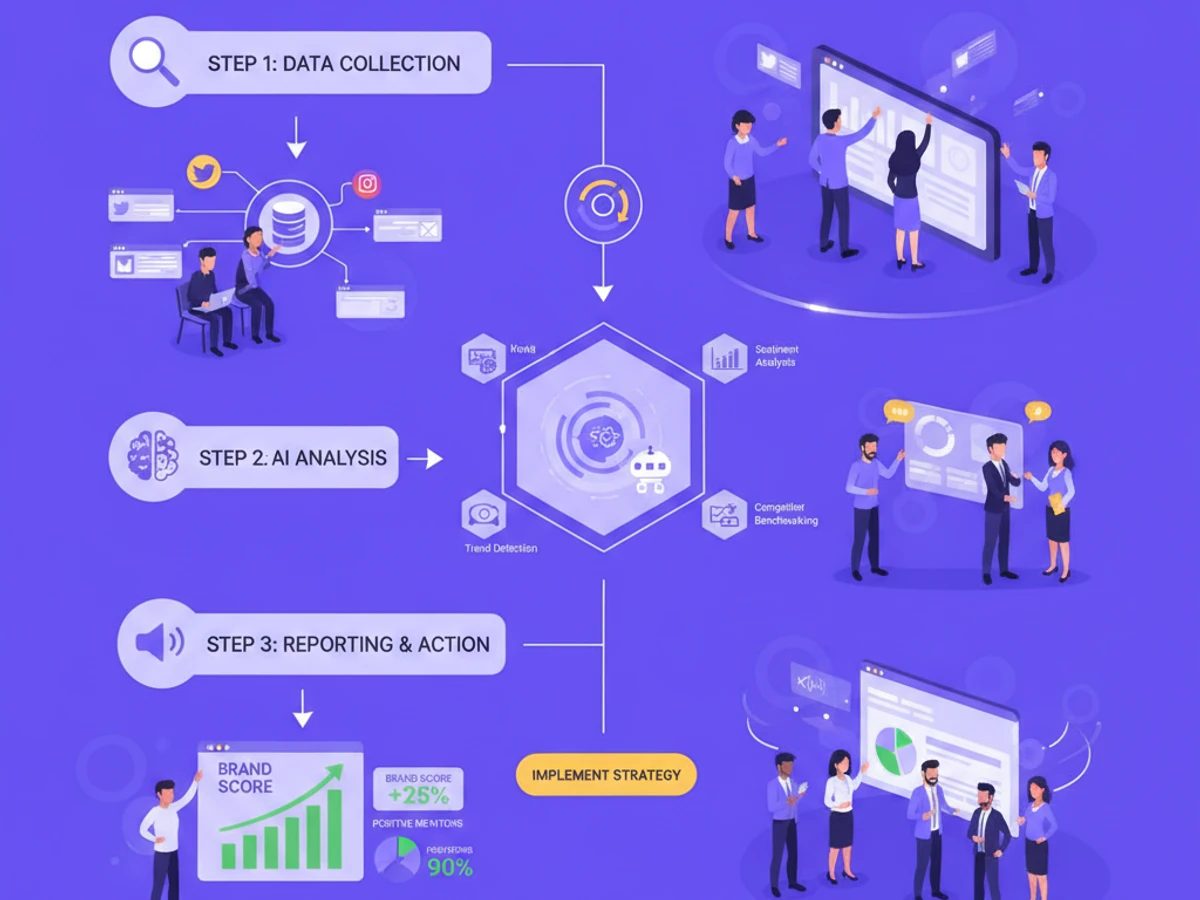
how to set up daily AI visibility tracking for your brand | Updated September 2026 | By the hyperank Editorial Team | Time required: 2-3 hours setup, then 10-15 minutes daily | Difficulty: Beginner
What You'll Learn
Your brand's presence on AI search engines like ChatGPT, Perplexity, Gemini, and Claude matters more than ever. AI visibility tracking is the automated process of monitoring how frequently and accurately generative AI models reference, recommend, or cite your brand. By the end of this guide, you'll have a complete framework to track performance and convert findings into real content growth:
- Define a 20-50 prompt tracking set that mirrors real customer queries across awareness, comparison, and purchase intent stages.
- Select primary AI search platforms including ChatGPT, Perplexity, Google Gemini, and Claude based on target buyer behavior.
- Automate daily prompt execution using dedicated monitoring tools to build a consistent historical dataset.
- Establish a baseline visibility rate, defined as the percentage of tracked queries that yield brand mentions or citations.
- Convert recurring visibility gaps into marketing fixes, turning missed prompts into structured content updates, FAQ revisions, and PR outreach.
Prerequisites: A defined brand name, a short list of core products or services, and 2 to 3 hours for initial setup. No coding or technical SEO background required.
Why AI Visibility Tracking Matters in 2026
Generative AI has become a primary discovery layer ahead of traditional web search. Generative Engine Optimization (GEO) is the strategy of optimizing online content and brand presence so AI systems accurately cite and recommend a company. ChatGPT alone processes over 2.5 billion queries daily, and 89% of B2B buyers now consult generative AI during their purchasing journey, according to Forrester research. Meanwhile, Google AI Overviews trigger on roughly 48% of all searches, meaning many buyers never click through to a traditional search engine results page.
Unlike Google Search Console, AI chat interfaces provide almost no built-in visibility metrics. ChatGPT gives you no native impression data or analytics dashboards to view brand exposure. This visibility gap is driving rapid demand for tracking tools. Ahrefs reports searches for "ai search tracking" grew 184 percent and "ai rank tracking" grew 175 percent year over year. The real power comes from consistency: evaluating the same prompt set daily generates comparable, trendable datasets, which is the core operational cadence hyperank uses to track brand authority.
Key Takeaway: AI search engines hide native impression data, making daily automated prompt tracking essential for measuring your true market presence across generative discovery platforms. For supporting data, see Master AI Search Tracking for Brand Visibility Across AI ....
The Process at a Glance
| Step | Action | Time | Outcome |
|---|---|---|---|
| 1 | Define your brand prompt set | 30-60 min | 20-50 tracked prompts ready to run |
| 2 | Choose which AI engines to monitor | 15-30 min | Coverage plan across ChatGPT, Perplexity, Gemini, Claude |
| 3 | Set up a daily automated tracking tool | 30-45 min | Live daily prompt runs, no manual checking |
| 4 | Establish baseline and review cadence | Day 1, then 10 min/day | Benchmark visibility score to compare against |
| 5 | Turn daily insights into action | 15 min/day ongoing | Content and outreach fixes tied to real gaps |
Total time to launch: 2 to 3 hours of initial configuration, followed by a 10-minute daily monitoring routine.
Step 1: Define Your Brand Prompt Set
Your tracking system is only as good as the questions you feed it. Build a fixed set of 20 to 50 target prompts that mirror how real customers actually query AI search engines.
How to Do It
- List your core products, service capabilities, and buyer category terms.
- Draft 20 to 50 natural language prompts matching real customer phrasing. A recommended framework advises you to map the 20-50 queries your ideal customers ask AI assistants, such as "best CRM for startups" or "top project management tools for remote teams."
- Structure prompts across the entire buyer journey. Industry analysts emphasize that most brands over-rely on comparative prompts while ignoring informational, instructional, brand-specific, and transactional queries.
- Lock exact phrasing permanently. A consistent core prompt set across engines is required to evaluate shift trends accurately.
Best Practices
- Extract prompt ideas from organic keywords, "People Also Ask" search blocks, and online forum discussions like Reddit.
- Separate brand-versus-competitor comparison prompts from generic category queries to avoid skewing aggregate exposure metrics.
Example
| Prompt Type | Example Prompt | Funnel Stage |
|---|---|---|
| Informational | "What is the best way to track brand mentions in AI search?" | Awareness |
| Comparative | "Compare [Your Brand] vs [Competitor] for AI visibility tracking" | Consideration |
| Transactional | "Best AI visibility tracking tool for small marketing teams" | Purchase |
Key Takeaway: Standardize 20 to 50 customer-centric prompts across five intent categories to build a stable foundation for ongoing AI measurement. For a more detailed walkthrough, see How I Created the Perfect Prompt Set for AI Visibility ....
Step 2: Choose Which AI Engines to Monitor
Your brand might dominate one engine while remaining invisible on another. Select the specific generative AI engines to track daily based on where your ideal buyers actually spend time.
How to Do It
- Include the primary four engines: ChatGPT, Perplexity, Google Gemini, and Anthropic Claude. AI visibility tracking measures how often systems like ChatGPT, Google Gemini, Anthropic Claude, and Perplexity mention your brand.
- Add Google AI Overviews if your product relies on organic web search discovery.
- Analyze each platform surface independently rather than relying on a single aggregated blend score.
- Adopt continuous oversight. Modern AI brand management works as a loop: audit baseline, understand engine differences, monitor continuously, earn citations, then re-audit.
Best Practices
Maintain separate reporting streams per platform. A brand can dominate ChatGPT answers while remaining invisible in Perplexity due to differing retrieval methods.
Example
| Engine | Typical Visibility Behavior |
|---|---|
| ChatGPT | Combines offline training data with web browsing; favors established brands |
| Perplexity | Performs live web indexing; highly favors recent, cited web content |
| Google Gemini / AI Overviews | Tied closely to Google search index signals and traditional SEO authority |
Step 3: Set Up a Daily Automated Tracking Tool
Replace manual testing with automated daily tracking. Connect your finalized prompt set to a dedicated monitoring platform that executes checks every 24 hours.
How to Do It
- Select software engineered for automated daily recurring runs. Specialty platforms let you define target prompts and run them daily to build comparable historical datasets.
- Import your standardized prompt list from Step 1 and connect your selected AI platforms from Step 2.
- Set the run frequency to 24-hour intervals for commercial and brand prompts. This daily cadence is central to hyperank, engineered to evaluate brand positioning, capture complete engine responses, and provide structured competitive insights across AI conversations.
- Ensure the tool captures four core data points per run: presence (yes/no mention), brand sentiment, competing brands cited, and cited source URLs.
Best Practices
- Choose a platform that archives complete raw text responses for investigation.
- Ensure competitor auto-discovery is enabled to identify which competing solutions AI models recommend instead of your brand.
Key Takeaway: Automate daily execution across platforms to capture full response text, cited URLs, sentiment, and recommended competitors automatically.
See where your brand stands in AI search
Find out how ChatGPT and other AI platforms understand, mention, and recommend your brand.
Check Your AI visibilityStep 4: Establish Your Baseline and Daily Review Cadence
Establish a clear baseline visibility rate across all tracked engines and create a daily 10-minute review habit to separate meaningful trends from random variation.
How to Do It
- Run an initial baseline assessment. Run a manual baseline first to locate your standing, then configure daily automated monitoring for priority brand and purchase-intent queries.
- Focus on visibility rate over static rank position. Visibility rate is the percentage of tracked prompts in which an AI system mentions or cites a specific brand. Tracking the percentage of prompts that mention your brand across 200 runs provides meaningful data, whereas a single snapshot rank is uninformative.
- Document initial baseline visibility scores across platforms in your tracking software.
- Schedule a 10-minute daily morning review to audit sentiment flags, new competitor appearances, and lost citations.
Step 5: Turn Daily Insights Into Action
Convert daily AI tracking findings into actionable marketing tasks by addressing recurring gaps with content updates, FAQ additions, and strategic PR outreach.
How to Do It
- Isolate prompts where competitors are recommended while your brand is missing, or where brand details are inaccurate.
- Cluster query gaps into broad content themes. Group prompt clusters and evaluate aggregated responses, cited URLs, and trends simultaneously.
- Assign each recurring gap to a specific marketing owner. Every recurring answer gap must drive a page update, brief, FAQ addition, or citation campaign.
- Re-evaluate prompt responses 14 days after publishing updates to confirm improved brand presence.
Key Takeaway: Convert recurring visibility gaps into clear content fixes, and measure prompt outcomes 14 days post-publishing to verify recommendations.
What to Do After Setting Up Daily AI Visibility Tracking
Phase 1 (Weeks 1-4): Confirm baseline stability, expand your query set to 50 total prompts across all funnel stages, and solidify the 10-minute daily inspection habit.
Phase 2 (Months 2-3): Implement direct competitor benchmarking to discover why AI platforms choose competing solutions over yours.
Phase 3 (Month 4+): Integrate AI citation requirements into content briefs and PR workflows, ensuring new web pages explicitly answer queries where AI models currently lack source material.
Resources You'll Need
| Resource | Role | Requirement Level | Cost |
|---|---|---|---|
| hyperank | Automated daily AI visibility tracking, citation capture, and competitor benchmarking | Required | Paid plans |
| Google Sheets | Structure initial prompt lists and maintain baseline logs | Recommended | Free |
| Ahrefs Free AI Visibility Checker | Perform preliminary manual spot-checks before launching automated runs | Optional | Free |
| Notion | Organize team task assignments for content and FAQ updates | Optional | Free tier available |
See also, see 5 Best AI Brand Visibility Tracking Tools Compared.
Common Plateaus and How to Break Through
Visibility numbers swing wildly day to day
Likely cause: Your tracked prompt set is too small, or prompt text changes between runs. AI responses are less consistent than organic search results, with brand mentions and cited URLs changing rapidly. Fix: Lock your exact prompt phrasing, track at least 20 to 50 prompts, and evaluate 7-day moving visibility averages rather than single-run results.
Your brand shows up in ChatGPT but never in Perplexity
Likely cause: Engines utilize different retrieval sources. A brand present in 60% of ChatGPT queries might achieve only 15% in Perplexity because Perplexity relies heavily on live web crawling. Fix: Segment platform reporting and publish clear, fresh digital content structured for live search crawlers.
The team stops checking the dashboard after two weeks
Likely cause: Lack of operational ownership and clear action protocols. Fix: Designate one team member to complete the 10-minute daily review and require every weekly gap report to generate at least one assigned marketing task.
You can't tell if a dip is a real trend or normal noise
Likely cause: Absence of archived response histories or altered query wording. Historical data logs, stable prompt sets, and exportable reports are essential for proving real trends. Fix: Maintain fixed prompt phrasing for at least 30 consecutive days and evaluate performance against recorded baseline averages.
Key Takeaway: Smooth out daily answer variance by locking prompt phrasing, measuring 7-day moving averages, and evaluating platform scores independently. For more troubleshooting advice, see Aleyda Solís' Post.
Conclusion
Setting up daily AI visibility tracking transforms speculative marketing into accurate, data-driven workflow. By locking a core prompt set, automating 24-hour evaluation runs, and executing daily 10-minute reviews, you build a durable system for managing your brand's AI reputation.
Key Takeaways
- A locked query library of 20 to 50 real buyer questions checked daily across ChatGPT, Perplexity, Gemini, and Claude forms the foundation of reliable tracking.
- Aggregate visibility rate measured over daily runs is far more reliable than single snapshot rank positions.
- Systematic progress requires converting daily prompt gaps into concrete web page updates, FAQ improvements, and third-party citation outreach.
FAQ
How do I set up daily AI visibility tracking for my brand?
Assemble a fixed library of 20 to 50 target prompts that mirror customer questions across all funnel stages. Choose your primary target platforms-ChatGPT, Perplexity, Gemini, and Claude-and connect your query set to an automated tracking tool like hyperank for 24-hour execution. Record an initial baseline visibility rate and perform a daily 10-minute audit to convert answer gaps into targeted content updates.
How many prompts should I track daily?
Most organizations start by tracking 20 to 50 high-intent prompts covering informational, comparative, and purchase queries.
Is daily tracking necessary, or is weekly enough?
Daily tracking is recommended for high-intent and commercial queries because AI outputs fluctuate frequently, and daily execution provides the data volume needed to separate real shifts from output variance.
What's the difference between an AI mention and an AI citation?
An AI mention occurs when a generative engine names your brand in its text response, whereas an AI citation occurs when the platform provides an explicit hyperlink to your website as a reference source.
Should I track ranking position or visibility rate?
Visibility rate is the superior metric because AI answer structures vary per query, making the presence or absence of a brand mention across multiple runs far more consistent than a static rank number.
How do I choose which AI engines to prioritize?
Select platforms based on customer usage: prioritize Google Gemini and AI Overviews for traditional search-driven categories, and prioritize ChatGPT, Perplexity, and Claude for technical or conversational buyer research.
What should I do with the daily data once I have it?
Group recurring query gaps into themes, assign specific content or PR fixes to team members, update your digital content, and review tracked prompt results 14 days later to confirm improved visibility.
How long until I see measurable improvement in AI visibility?
Most organizations observe initial visibility improvements within 4 to 8 weeks of starting daily tracking, provided they actively publish weekly content updates and citation improvements.
Methodology: This guide synthesizes publicly available industry research, platform documentation, and analyst commentary on AI search and generative engine optimization current as of September 2026. Visibility benchmarks and statistics cited are sourced from the respective publishers linked throughout; readers should verify current pricing and feature sets directly with each tool before purchasing.
See where your brand stands
How six AI engines describe you, next to your competitors. About two minutes.